Colombian Green Coffee Supplier Guide: Sourcing Supremo, Excelso and Specialty Arabica
At a Glance
Colombian green coffee sourcing is the purchase of unroasted, washed Arabica beans from Colombia, bought by grade (Supremo, Excelso or specialty), against a written specification, an export quality certificate and an agreed price basis, usually the ICE Coffee "C" futures plus a differential.
USDA forecasts Colombian coffee production for marketing year 2026/27 at 13.4 million 60 kg bags (green bean equivalent), up 7.2% on the previous year, with exports also forecast at 13.4 million bags.[1]
What you'll learn
- How Colombian export grades differ, from Supremo 17/18 to Excelso EP and SCA-scored specialty lots
- When Colombia harvests, how coffee is graded and certified for export, and how the price is built
- A step-by-step process to specify, inspect, document and contract a Colombian green coffee purchase

By the XRT Group Trade Desk: the XRT Group procurement desks in Houston, USA and Medellín, Colombia that source, inspect, and ship these commodities for industrial buyers.
Last updated . Market figures come from the primary sources listed under References and were checked against them before publication.
What Is Colombian Arabica Green Coffee?
Colombian green coffee is washed Arabica grown in the Andes and exported unroasted, sold by bean size and preparation and backed by an export quality certificate issued in Colombia.
Green coffee is the raw, unroasted seed of the coffee cherry. Roasters, importers and blenders buy it green because it stores far better than roasted coffee, and they control the roast themselves. Colombia grows Arabica and is known for washed (wet-processed) coffee: the cherry is pulped, fermented, washed and dried before milling.
Origin carries legal weight. Café de Colombia was registered as a protected geographical indication (PGI) in the European Union in 2007 by Commission Regulation (EC) No 1050/2007, the first non-European food product to receive that status.[2] Coffee sold under the name must be grown and processed in the defined Colombian coffee zone.
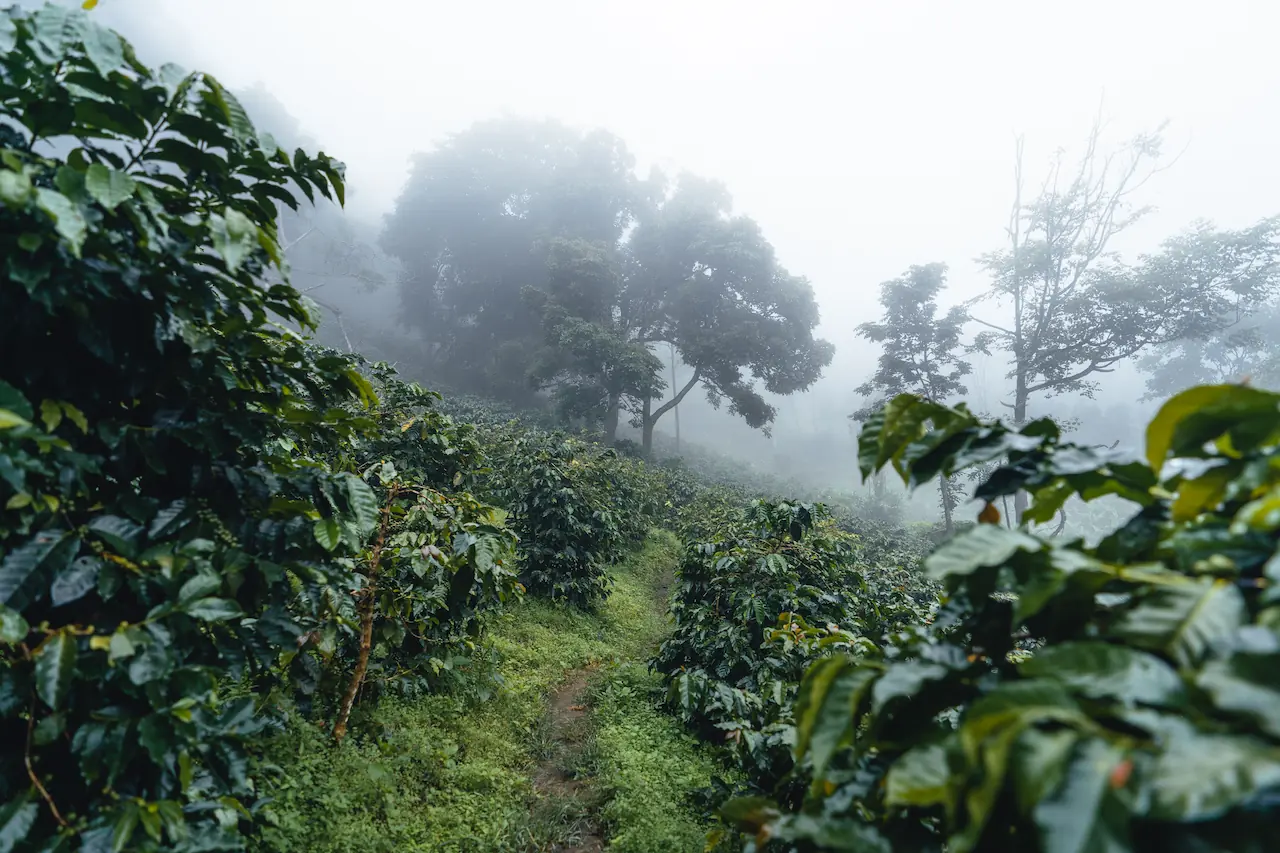
Colombia's coffee belt follows the three branches of the Andes. Main producing departments include Huila, Antioquia, Tolima, Cauca, Nariño, Santander, Valle del Cauca and the Eje Cafetero of Caldas, Risaralda and Quindío. Altitude, rainfall and microclimate vary sharply between them, which is why two Colombian lots of the same grade can cup very differently.
XRT Group coordinates Colombian Arabica origination from its Medellín hub, working with the Houston desk on contracts, documents and buyers in North America and Europe. You can review the full scope of support on our procurement services page. The first decision for any buyer is the grade.
What Is the Difference Between Colombian Supremo, Excelso and Specialty Coffee?
Supremo and Excelso describe bean size after screening, EP and UGQ describe how strictly defects are sorted out, and specialty lots are bought on cup score rather than size.
Colombian exports are classed by screen size, the hole diameter of the sorting sieve in 64ths of an inch. Larger, even beans roast more uniformly, so size carries a premium. Preparation then sets how many defective beans are tolerated.
| Grade | What it means | Typical buyer | Buyer note |
|---|---|---|---|
| Supremo 17/18 | Large beans retained on screens 17 and 18 | Roasters wanting a premium single origin | Smaller share of each harvest; priced above Excelso |
| Excelso 15/16 | Medium beans retained on screens 15 and 16 | Roasters and blenders buying core volume | The workhorse Colombian export grade |
| Excelso EP | European Preparation: a cleaner, more tightly sorted Excelso | European and quality-focused North American roasters | Write the defect allowance into the contract |
| Excelso UGQ | Usual Good Quality: the standard commercial preparation | Blenders and price-led programs | Lowest cost of the three Excelso descriptions |
| Specialty (microlot or regional) | Bought on cupping score, farm or region and process | Specialty roasters and importers | Traceable to farm or cooperative; smaller lots |
Colombia's National Coffee Committee sets the minimum quality any coffee must meet to leave the country as Excelso. Its Resolution 2 of 2016 allowed a tolerance of up to 5% of sound smaller beans, while keeping the minimum requirements for moisture, defects, infestation, aroma, color and cup.[3]
XRT Group quotes three Colombian lines: Colombian Excelso EP (Green Arabica), Colombian Supremo 17/18 (Green Arabica) and Colombian Specialty Arabica (SCA 84+). Grade sets the baseline, but timing sets availability.
When Is the Colombian Coffee Harvest: Main Crop and Mitaca?
Colombia harvests coffee in two peaks, a main crop from October to December and a smaller mitaca from April to June, so fresh-crop coffee is available more of the year than from most origins.
Because the coffee belt straddles the equator's rainy and dry seasons, Colombia does not have a single harvest. USDA describes a primary harvest from October to December and a secondary mitaca crop from April to June, concentrated in the central coffee region, with some areas harvesting year-round.[1]
- Main crop: the largest volumes and widest grade choice; plan core contracts around it.
- Mitaca: a smaller second picking that keeps fresh coffee moving in the first half of the year.
- Regional timing: harvest windows shift by department and altitude, so confirm the crop period of the exact lot you are offered.
Supply is structurally fragmented. USDA estimates that around 60% of Colombian coffee is produced on less than 5 hectares.[1] Exporters therefore consolidate many small farm deliveries of parchment coffee before dry milling, grading and bagging. That consolidation is where quality control matters most.
How Is Colombian Coffee Quality Checked Before Export?
Colombian green coffee exports are sampled by Almacafé for a Colombian quality certificate; buyers then add their own pre-shipment sample approval and, where needed, an independent inspection.
Colombia runs a formal export control. When coffee reaches the port or airport, Almacafé, the logistics arm of the National Federation of Coffee Growers (FNC), samples it and issues a quality certificate confirming it meets the National Coffee Committee's rules, alongside a reweigh certificate.[4]
Internationally, ICO Resolution 420 sets target export standards for Arabica: no more than 86 defects per 300 g sample and moisture between 8% and 12.5%, measured under ISO 6673.[5] Many buyers write a tighter moisture band, such as 10–12%, into the contract to protect the coffee in storage.
For specialty coffee, the cup decides the price. Lots scoring 80 points or more on the Specialty Coffee Association scale have long been treated as specialty grade. In November 2024 the SCA adopted the Coffee Value Assessment (CVA), which supersedes its 2004 cupping form and protocol.[6] Agree which protocol and which Q grader will score the approval sample.
- Offer sample: evaluate grade, screen, moisture, defects and cup before you commit.
- Pre-shipment sample (PSS): approve a sample drawn from the milled lot before it is bagged and loaded.
- Independent inspection: XRT Group can arrange SGS, Bureau Veritas or Intertek to check weight, bagging and condition at loading. Our guide on how to read and verify an SGS inspection report shows what to look for.
How Is Colombian Green Coffee Packed and Shipped?
Colombian green coffee ships in 70 kg natural-fibre bags, often with hermetic liners for specialty lots, mainly from Buenaventura on the Pacific and Cartagena and Santa Marta on the Caribbean.
The Colombian standard is a 70 kg bag of fique, a natural fibre, measuring 70 by 95 cm; polypropylene bags, big bags and bulk container liners are also used.[4] Statistics, by contrast, are reported in 60 kg bags, so convert carefully when comparing volumes. A 20-foot container commonly carries about 275 bags of 70 kg, roughly 19.25 MT.
- Hermetic liners such as GrainPro bags slow moisture exchange and are common for specialty and long-transit lots.
- Container lining with paper or cardboard, and desiccants where needed, reduces condensation damage at sea.
- Pacific port: Buenaventura is the main outlet for coffee from the southern and western growing regions.
- Caribbean ports: Cartagena and Santa Marta serve northern growing areas and Atlantic shipping lines.
Most Colombian green coffee trades FOB a Colombian port or CFR/CIF a destination port. Our Incoterms 2020 guide for commodity buyers explains where risk and cost pass under each term. With the physical side set, the next question is price.
How Is Colombian Green Coffee Priced?
Colombian green coffee is usually priced as the ICE Coffee "C" futures price plus a differential that reflects grade, quality, certification and shipment period.
The global benchmark for washed Arabica is the ICE Coffee "C" futures contract (KC), quoted in US cents per pound on lots of 37,500 lb. Colombia is a deliverable origin at a 1000-point (10 cents per pound) premium to the par origins.[7]
Physical contracts add a differential to the futures price. Supremo, EP preparation, certifications and high cup scores raise it; commercial UGQ coffee sits lower. Specialty microlots are often sold at a fixed flat price instead of a differential.
Inside Colombia, the FNC publishes a daily domestic reference price for parchment coffee, built from the ICE "C" close, the peso exchange rate and the Colombian differential, and backs it with a purchase guarantee for growers.[8] That floor shapes what exporters must pay farmers and therefore what they can offer. Our commodity pricing benchmarks guide covers how to fix price against a futures market.
- Price-to-be-fixed (PTBF): agree the differential now, fix the futures price later within an agreed window.
- Outright: fix futures and differential together at signing.
- Flat price: a single fixed price per pound or per kilogram, common for specialty lots.
What Documents and Compliance Rules Apply to Colombian Coffee Imports?
Expect an ICO certificate of origin, an Almacafé quality certificate and an ICA phytosanitary certificate from Colombia, plus FDA Prior Notice and FSVP for the US or EUDR due diligence for the EU.
On the Colombian side, the exporter announces the sale to the FNC, pays the coffee contribution, and obtains the reweigh and Almacafé quality certificates. The FNC then issues the ICO certificate of origin, and green coffee needs an ICA phytosanitary certificate.[4] Commercial invoice, packing list and bill of lading complete the set.
United States. Every food shipment, including green coffee, needs FDA Prior Notice, filed and confirmed at least 8 hours before arrival by water.[9] The US importer also owes a Foreign Supplier Verification Program (FSVP); for raw coffee that is roasted before consumption, FDA's rule offers simplified paths when a later processor controls the hazard and this is disclosed in the documents.[10]
European Union. Coffee is a commodity under the EU Deforestation Regulation (EUDR). Regulation (EU) 2025/2650 set its application date at 30 December 2026 for large and medium operators and traders and 30 June 2027 for micro and small operators.[11] Importers need plot geolocation and a due diligence statement for each lot. Our EUDR deadline guide walks through the data requirements, which apply to coffee in the same way.
Certifications such as Rainforest Alliance, Fairtrade and organic are available on a lot basis. Ask for the current certificate and transaction documents with each offer, since certification belongs to the producer group, not the grade.
How Do You Buy Colombian Green Coffee Step by Step?
Define the grade and cup profile, screen the exporter, approve samples, fix the price basis, then inspect and document every lot before it ships.
A Colombian coffee purchase runs from sample to shipment over several weeks, and each step protects quality or cash. A clear tender saves time; our commodity procurement RFP template shows how to structure one.
The steps below follow the order most roasters and importers use. You can start the process through our request for quotation form.
- 1
Define the grade, profile and volume
State the grade (Supremo 17/18, Excelso EP or UGQ, or specialty score range), region if required, moisture band, certifications, number of bags or containers and shipment months.
- 2
Screen the exporter
Confirm the exporter is registered with the FNC as a coffee exporter, and complete KYC/AML and sanctions checks in line with FATF guidance.
- 3
Approve offer and pre-shipment samples
Cup and grade the offer sample, then approve a pre-shipment sample drawn from the milled lot, using an agreed cupping protocol and Q grader.
- 4
Agree the price basis and incoterm
Set the ICE Coffee "C" contract month and differential, or a flat price, plus the incoterm (FOB Cartagena or Buenaventura, CFR or CIF destination) and payment terms.
- 5
Prepare compliance files
Collect EUDR geolocation and due diligence data for EU shipments, or set up FSVP records and FDA Prior Notice for US shipments.
- 6
Inspect, load and release documents
Check the Almacafé quality certificate, arrange independent inspection of weight and bagging if needed, and release payment against the certificate of origin, phytosanitary certificate and bill of lading.
- 7
Receive and check arrival quality
On arrival, test moisture and cup an arrival sample against the approved pre-shipment sample, then store bags cool, dry and off the floor.
What Are the Best Practices for Sourcing Colombian Green Coffee?
The strongest Colombian coffee programs buy on measurable grade and cup specs, contract across main crop and mitaca, and settle compliance data before the coffee leaves the mill.
- Buy on specification: write screen, preparation, moisture, defect count and cup score into the contract, not just "Excelso".
- Spread shipments: split volume across main crop and mitaca to smooth freshness and price risk.
- Manage price risk: use price-to-be-fixed contracts and an agreed fixation window rather than guessing the C market.
- Approve before loading: never ship without an approved pre-shipment sample from the actual lot.
- Settle compliance early: collect EUDR geolocation or FSVP records before contracting, not at the port.
Counterparty checks matter as much as cup quality. Our KYC and AML guide for direct-origin buyers sets out what a supplier file should contain.
When you are ready to source, the Coffee Desk, coordinated between Medellín and Houston, answers buyer inquiries in under 4 business hours. Contact the Coffee Desk with your grade, volume, destination and shipment window, or browse all product lines.
Explore the Full Colombian Coffee Toolkit
Product specifications
- Colombian Excelso EP (Green Arabica)
Excelso EP / Screen 15+. Colombia (Huila, Antioquia, Tolima, Cauca). Min. 1 FCL.
- Colombian Supremo 17/18 (Green Arabica)
Supremo / Screen 17/18. Colombia (Huila, Antioquia, Caldas, Nariño). Min. 1 FCL.
- Colombian Specialty Arabica (SCA 84+)
Specialty / SCA 84+. Colombia (Huila, Nariño, Antioquia, Cauca). Min. 1 FCL.
Deep-dive guides
- EUDR Beef Deadline: Preparing for 30 December 2026
Regulation (EU) 2025/2650 moved the EUDR start to 30 December 2026 for large and medium operators and 30 June 2027 for micro and small ones. What geolocation data, due diligence, and export documentation beef exporters must prepare before the deadline.
- How to Read and Verify an SGS Inspection Report in Commodity Transactions
A buyer's guide to understanding SGS reports, verifying report authenticity, spotting fraud patterns, and specifying third-party inspection correctly in commodity contracts.
- INCOTERMS 2020 Explained for Commodity Buyers: FOB, CIF, DAP, and DDP
A practical breakdown of INCOTERMS 2020 for procurement directors sourcing crude oil, diesel, edible oils, beef, and coffee. Understand what FOB, CIF, DAP, and DDP mean for your risk, cost, and logistics structure.
- Commodity Pricing Benchmarks: A Procurement Guide for Industrial Buyers
A guide to commodity benchmark pricing across energy, edible oils, beef, and coffee, with practical guidance on fixed, floating, collar, and average-price contract mechanisms.
- Commodity Procurement RFP Template & Guide
A commodity RFP forces suppliers to bid against your specification, not your price history alone. The sections, evaluation criteria, and mistakes that separate qualified commodity suppliers.
- KYC & AML in Commodity Trading: Direct-Origin Buyers
Trade-based money laundering runs on fake invoices, layered ownership, and unverifiable chains. What a real commodity KYC file contains and the red flags compliance teams must catch.
FAQ
Is all Colombian coffee Arabica?
Colombia's export coffee is Arabica, and the Café de Colombia name protected in the EU covers washed Arabica grown in the Colombian coffee zone. Colombia does import some lower-grade coffee from neighbouring origins for its soluble industry, so ask for the Colombian ICO certificate of origin with every lot.
What does 17/18 mean in Colombian Supremo?
It refers to screen size. Sorting sieves are measured in 64ths of an inch, and Supremo 17/18 beans are retained on screens 17 and 18. Excelso beans are smaller, typically screens 15 and 16. Larger, more uniform beans roast more evenly, which is why Supremo carries a premium.
What is the difference between Excelso EP and Excelso UGQ?
Both are Excelso by size. EP, European Preparation, is sorted more tightly to remove defective and foreign matter, while UGQ, Usual Good Quality, is the standard commercial preparation. Because exact tolerances vary between exporters, write the agreed defect count into the contract.
How much coffee fits in a container from Colombia?
Colombian green coffee ships in 70 kg bags, and a 20-foot container commonly carries about 275 bags, roughly 19.25 metric tons. Remember that production and export statistics are quoted in 60 kg bags, so convert before comparing volumes.
Does Colombian green coffee need EUDR compliance?
Yes, for coffee placed on the EU market. Under Regulation (EU) 2025/2650, large and medium operators and traders must comply from 30 December 2026, and micro and small operators from 30 June 2027. Importers need geolocation data for the producing plots and a due diligence statement for each lot.
Are certified Colombian coffees available?
Rainforest Alliance, Fairtrade and organic Colombian coffees are available on a lot basis. Certification belongs to the farm or producer group, so request the current certificate and transaction documents with each offer and confirm the certified volume matches your contract.
Key Takeaways
- Specify Colombian coffee by screen, preparation, moisture and cup score, not by name alone; Supremo, Excelso EP and UGQ trade at different differentials.
- Plan purchases around the October to December main crop and the April to June mitaca, and price off the ICE Coffee "C" contract plus an agreed differential.
- Settle documents early: Almacafé quality and ICO origin certificates from Colombia, FDA Prior Notice and FSVP for the US, and EUDR due diligence for the EU.
Talk to the Colombian Coffee desk about volumes, specifications, and delivery terms. Responses within four business hours.
References
- USDA Foreign Agricultural Service, Colombia: Coffee Annual, GAIN report CO2026-0008 (May 2026)
- European Commission, Commission Regulation (EC) No 1050/2007 registering Café de Colombia (PGI) (2007)
- La República, La FNC modificó normas de exportación de café (Resolution 2 of 2016) (2016)
- ProColombia, Guía para la exportación de café (2024)
- International Coffee Organization, Resolution 420: Coffee Quality-Improvement Programme
- Daily Coffee News, SCA Officially Adopts New Cupping Forms and Standards (November 2024)
- Intercontinental Exchange, Coffee C Futures contract specifications (2026)
- Federación Nacional de Cafeteros de Colombia, ¿Cómo se conforma el precio del café? (2026)
- US Code of Federal Regulations, 21 CFR Part 1 Subpart I: Prior Notice of Imported Food
- US Food and Drug Administration, FSMA Final Rule on Foreign Supplier Verification Programs (FSVP)
- European Union, Regulation (EU) 2025/2650 amending Regulation (EU) 2023/1115 on deforestation-free products (December 2025)