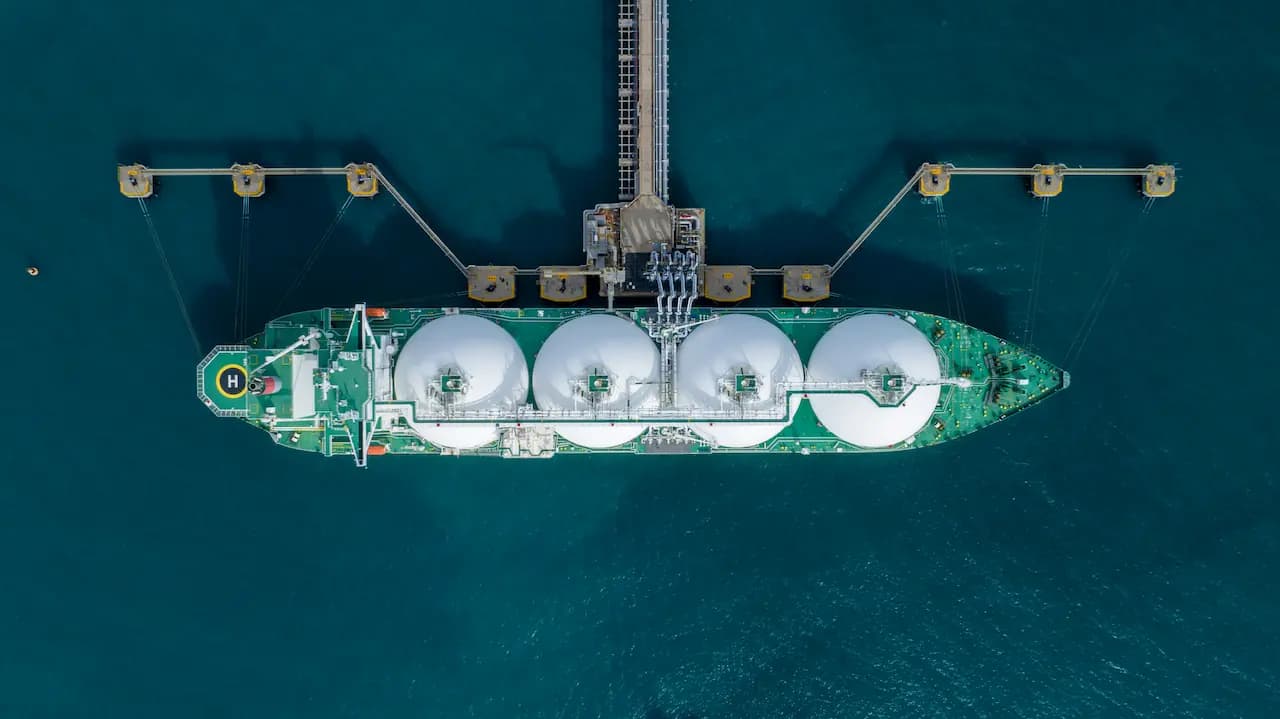
The Houston-Galveston region is one of the largest U.S. export gateways for refined products, and the Ship Channel's terminal capacity, depth, and berth queues decide whether your fuel cargo loads next week or several weeks from now. The EIA tracks these Gulf Coast flows in its Today in Energy series, which is the best public window into the region's export balance.
Every international fuel buyer has watched a Houston cargo drift. The vessel slots, the terminal slips a window, fog or traffic stacks up the channel transits, and suddenly the CIF date you quoted your customer is a revised plan instead of a commitment.
This guide explains how Houston Ship Channel dynamics actually work: what infrastructure moves fuel out of the region, how terminal expansion changes the export picture, how vessel size and channel depth create queues, and how a buyer should qualify a Houston-based supplier so lead time and price remain predictable.
Table of Contents
- How do Houston Ship Channel dynamics affect fuel export pricing and lead times?
- What infrastructure actually moves fuel out of Houston?
- How is Gulf Coast export capacity expanding?
- How do vessel size and channel depth create export queues?
- What do Houston queues mean for international fuel buyers?
- How should a buyer qualify a Houston-based fuel supplier?
How do Houston Ship Channel dynamics affect fuel export pricing and lead times?
Houston Ship Channel conditions affect fuel exports through three levers — terminal loading capacity, channel traffic and weather, and vessel size economics — and all three show up in your lead time and your basis.
When the channel is flowing, Houston is one of the most efficient fuel-loading systems in the world: pipelines connect refineries to deep-water docks, and cargoes load around the clock. When it compresses — after a freeze, during fog closure, or when too many vessels chase the same docks — export slots push out, and the marginal barrel price responds immediately because buyers start chasing the same remaining capacity.
- Lead time: your supplier's booking position decides your load window. In peak months, that position is measured in weeks, not days.
- Pricing: the basis in your quote reflects the queue; a supplier with committed slots quotes differently from one hoping to buy a slot at the last moment.
- Reliability: the difference between a planned load and a slipped load is often just the supplier's terminal relationship.
That relationship is the real product the buyer is buying, so let us look at what infrastructure actually moves the fuel.
What infrastructure actually moves fuel out of Houston?
Three layers move fuel out of Houston: refinery-to-terminal pipelines, deep-water docking infrastructure, and offshore lightering operations that top off vessels the channel cannot fully load.
- Pipelines and racks: most refined product reaches terminal tanks by pipeline rather than truck, which keeps volumes high and product quality consistent.
- Deep-water docks: the channel handles substantial draft vessels, though the deepest-draft ships — including fully loaded VLCCs — cannot transit the channel and use offshore transfer instead.
- Lightering zones: partially loaded vessels top off at sea, adding an operation, a weather dependency, and a day of schedule risk to every deep-sea cargo.
For buyers of deep-sea cargoes this means one more planning variable: the load is not always finished when the vessel leaves the dock. LNG is a separate system: no LNG export terminal sits on the Houston Ship Channel, and the Gulf Coast's LNG exports load at dedicated terminals elsewhere on the Texas and Louisiana coast.
How is Gulf Coast export capacity expanding?
Gulf Coast export capacity is expanding through new and expanded docks, deeper berths, and a new generation of terminals designed for bigger vessels and faster loading cycles.
The expansion cuts both ways for buyers. More capacity means more total volume can load, which relieves structural queues. But construction, dredging, and commissioning add temporary congestion, and the largest projects are net diesel and bunker consumers during their build-out phase.
| Expansion type | What it changes | Buyer impact |
|---|---|---|
| New deep-water docks | Larger vessels load in-channel | Fewer steps, shorter queue |
| Berth additions | More simultaneous loading | More scheduling flexibility |
| Pipeline-to-dock shortcuts | Faster refinery-to-vessel flow | Stable quality and timing |
| Offshore lightering capacity | More VLCC cycles per week | Better export economics |
Capacity growth explains the direction of the market; the queue explains the timing. And the queue comes back to the channel's physical limits: depth, dock count, and the traffic that can move through a single corridor.
How do vessel size and channel depth create export queues?
The channel's depth caps how much a large tanker can load at the dock, so the biggest cargoes — above all VLCC crude exports — need offshore lightering, while refined product tankers queue for the limited number of product docks and for channel transits.
Refined products typically move on medium-range and long-range product tankers that load at channel docks, so their queue is about dock availability and transit timing. VLCC crude cargoes run on a different chain of partial loading and ship-to-ship transfer offshore. When many vessels schedule in the same week, product docks fill, channel transits stack, and weather windows gate any offshore legs.
- Dock occupancy: product docks are a finite resource; a delayed vessel on the berth pushes back every nomination behind it.
- Weather gating: fog closes the channel to transits and high seas pause offshore transfers, and the queue absorbs the delay either at the dock or at anchor.
- Bunkering ripple: while the queue builds, the vessels waiting at anchor are also demanding bunkers — tightening the very marine fuel supply we describe in our MARPOL BDN and MGO guide.
The queue is not a sign of failure; it is the physics of the region. The problem for buyers is when the queue becomes structurally longer than the booking horizon.
What do Houston queues mean for international fuel buyers?
For international buyers, a long Houston queue means three practical changes: earlier booking, firmer Incoterms, and a supplier who holds terminal slots rather than promises them.
- Book earlier: a lead time that used to be two weeks becomes four to six in a compressed month. Buyers who plan quarterly programs absorb this; spot buyers pay the premium.
- Use delivery Incoterms: under CIF or CFR the supplier carries the queue risk. Under FOB Houston, the buyer owns the berth problem and the demurrage exposure.
- Verify slots: ask for the actual berth window in the offer. A spot quote without a berth is an option on a slot the seller does not have.
- Diversify ports: Beaumont, Corpus Christi, and New Orleans load the same product families and relieve single-point exposure for buyers with flexible routing.
Buyers who treat Houston as one node in a Gulf Coast system — not as the only node — keep their programs running when the channel compresses.
How should a buyer qualify a Houston-based fuel supplier?
Qualify a Houston supplier on four things: terminal relationships, committed berth slots, inspection and documentation discipline, and a track record that names vessels, terminals, and ports.
| Qualification test | Why it matters |
|---|---|
| Named terminals and berth slots in the offer | Separates committed supply from position trading |
| Inspection company named in the contract | Guards quality through the lightering chain |
| Documentation from load to discharge | Protects customs, insurance, and payment |
| Recent delivery references you can call | Verifies the queue story is real |
Houston is a great origin when the supplier has the infrastructure relationship to match the offer. The region rewards preparation, and it punishes brokers who discover the berth shortage only after taking your volume.
Frequently Asked Questions
How important is Houston for U.S. petroleum exports?
The Houston-Galveston area is one of the largest U.S. export gateways for crude oil and refined products, served by a dense network of refineries, pipelines, and terminals. The EIA's Today in Energy series tracks these flows by port district.
What is a VLCC and why does it matter for fuel exports?
A VLCC is a Very Large Crude Carrier, typically carrying around 2 million barrels. Houston's channel depth prevents full loading, so VLCC crude cargoes rely on offshore lightering. Refined products usually move on smaller product tankers, so for fuel buyers the practical constraint is product dock availability rather than VLCC operations.
How long is the typical export queue in Houston?
Queue times swing with weather, channel traffic, and berth availability. In peak periods, loading windows can slip by weeks, which is why international buyers should hold term slots rather than chase spot availability.
Do Houston delays affect diesel prices in Europe?
Yes. Houston is a marginal supplier to European and Latin American buyers. When Gulf Coast export slots slip, Atlantic Basin pricing reacts within weeks because replacement barrels must travel from farther away.
What is the best Incoterm for Houston-sourced fuel?
For most buyers, CIF or CFR lets the supplier manage export coordination, while FOB works better when the buyer controls freight and destination inspection. Large programs often combine both across their supply portfolio.
Summary
Three takeaways for buyers sourcing fuel from Houston:
- Houston export dynamics are capacity, depth, and queue physics — bake them into lead times instead of discovering them on the fixture.
- Channel depth, dock availability, and weather create the structural queue; book berth-backed slots and prefer delivery Incoterms during compressed months.
- Qualify suppliers on terminal relationships and named berth windows, and diversify across Gulf Coast ports where routing allows.
Planning a Gulf Coast purchase? Submit a fuel RFQ or read the direct-origin framework in Direct-Origin Fuel Supply: Cost and Risk Breakdown.
References
- U.S. Energy Information Administration — Today in Energy: the primary public source for Gulf Coast petroleum export flows and regional infrastructure analysis used in this article.
- Port Houston: channel statistics, berth, and cargo data for the Houston Ship Channel complex.